
Community In Action
Explore real-world examples of collaborative living, shared responsibility, and community-led participation through MCA.
Collaborative living can take many forms, from shared housing arrangements to community-centered work spaces and resource sharing. These real-world examples show how people can come together to create supportive, sustainable, and community-led environments.
Shared Apartment Living
At this apartment building just outside of downtown Asheville, a garden flourishes. The people who live here tend it, sharing in the produce and beauty. They share duties like taking out the compost, pulling the garbage cans to the curb, sweeping the steps.
Payments made by the residents go into a shared account that funds repairs, improvements, and regular monthly payments to the property owner. Additionally, the empowered residents may make repairs and implement improvements using this shared resource.
Regular meetings keep communications open. Instead of voting, collaboration is used to find solutions. Everyone is included in the meetings, and minutes are shared with the community. The owners can participate with their own input, or allow the residents to take leadership.
This community did not spring magically into being, but as a result of the dedicated communication and collaboration of its members. As well, this group encourages each member to feel the responsibility and pride in ownership of the property.
A Deeper Look Into How This Community Model Functions
An Affordable Housing Solution
The point of this model is not to create or increase profit. Rather, profit dissolves as a motivator here as the group’s overall goal of affordable housing intends to be sufficiently supported by their own resources and abilities.
How MCA Supported This Community
When several units vacated at the same time, the executive director of Model Communities (who also lived there) approached the owner of the apartment building. Implementing this model would transform his relationship with his tenants from the traditional Landlord/Tenant hierarchy to one of shared community. Additionally, due to the self-governance of the residents and the Model Communities Association (MCA) managing the shared bank account, the amount of work and funds necessary for the owner to maintain and fund the property was reduced.
Living in a connected community attracts people. More than a few people have sought out MCA living arrangements because they want to live in a more connected environment. Our structure sets the intention to connect and comes with all of the benefits of doing so.
Making Agreements Creates a Home
Within the MCA structure, the tenants became residents in the community. As residents, they agree to the MCA creed which stipulates:
- Respect for People and Resources
- Participatory Contribution
- Collaborative Coordination
- Effective Communication
Read the full MCA Associate Creed here.
Along with this agreement, residents participate in regular meetings so that chores are shared equally, new projects can be initiated, and any other business of the building may be dealt with. The property owner may participate as well.
These collaborative meetings serve to keep the community engaged with each other as they use the toolset provided by the MCA. Learn more about the structure and tools here.
From these meetings, empowerment to make this property a real home emerges. The self-government of the residents permits a pride in the property with a dedication to make it a pleasant and well-kept space to live.
The occupancy agreement that each resident signs makes all of these requirements clear.
How Community Contributions Work
This same occupancy agreement delineates the monthly or weekly payment to be contributed by the resident.
These payments, made by the residents, go into a shared account that funds repairs, improvements, and regular monthly payments to the property owner. This account is managed by the MCA and shared with by members of the property’s “circle”. While this shared account may grow and the property owner may achieve profit from this arrangement, the intent here is not to make money or be profitable. This financial arrangement exists to fulfill the responsibilities of the community.
A Real-World Example
In a traditional landlord/tenant relationship, a tenant or group of tenants might approach the landlord with the idea of putting in a garden on the apartment building property. Since the landlord wants to maximize his profits and does not have any agreement with the tenants outside of a monetary one, his motivation to allow the tenants to put in a garden is low. Reducing all landscaping to the most basic and easily managed lawn with simple shrubs makes monetary sense.
Along with this profit issue, the landlord has no assurance that the tenants will continue to maintain the garden and not just abandon the garden when they leave. Nor do the tenants have any assurance that the landlord will not pull his consent without warning once he has granted it. This situation leaves everyone with feelings of uneasiness and distrust.
The MCA supported all of these aspects of installing and maintaining a garden.
In this apartment building, during the regular associate meeting (all of the participants in the MCA are called associates), one of the residents brought up the idea of creating a garden. With the consent and collaboration of the Apartment Building Circle (which includes the property owner), the residents who wanted to garden formed a Garden Circle to initiate and manage the garden. Duties within this circle include but are not limited to digging, planting, weeding, harvesting, and managing the compost. Everyone contributes and receives from this garden, including the property owner who owns a uniquely verdant apartment building.
Because of the collaborative nature of the MCA structure and the way that it builds trust among the participants, the property owner knows he can trust and rely upon the participants to manage this garden and keep it viable. The participants feel ownership and pride in the beauty of the garden and receive vegetables and flowers which can be shared throughout the building. They know they can trust the property owner to support them in the creation and management of this garden.
To help maintain this trust between associates, the MCA uses Tokens of Appreciation to build Trust Profiles. Read about these tools by clicking here.
The Outcome
Today, at this same apartment building, the results show on the street with flowers and vegetable plants displayed on every level and a garden surrounding the building. With the Model Communities Association managing the shared account, the owner can relax and enjoy the results. In turn, the residents have transformed this small apartment building on a sunny street into a home they are proud of, and where they can afford to live.
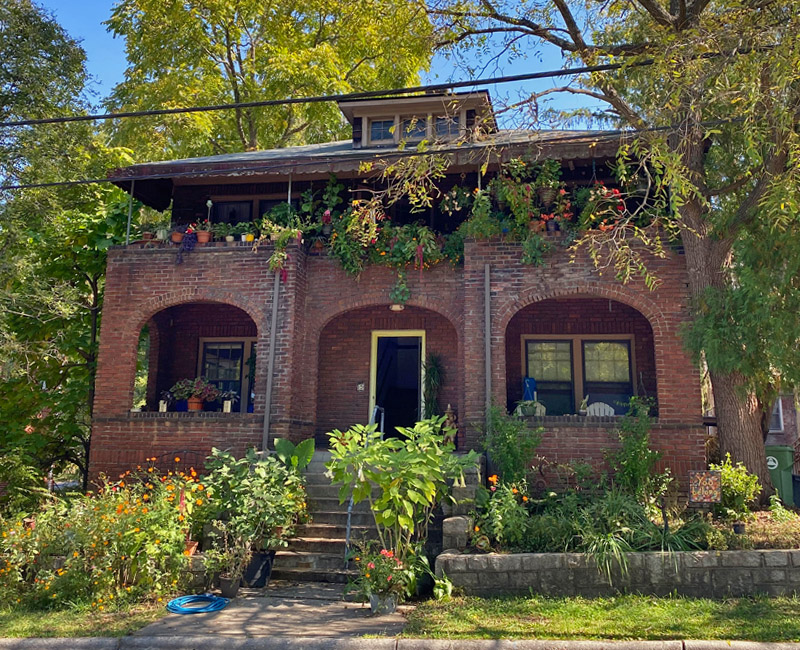

Shared Living Between Housemates
When entering the house on North Liberty Street in Asheville, NC, you immediately notice a peaceful energy in the communal atmosphere. The tree-sheltered roofed porch holds a melange of seating and tables grouped for easy conversations on this warm late summer day.
The usual rabbit warren of rooms discovered in any house from this era greet you, perfect for a multi-roommate solution. Throughout the residence, doors are shielded with curtains for added noise remediation.
A central kitchen snugs away toward the rear of the home. The group gathers for the monthly circle meetings in a sunny room adjacent to the kitchen.
Within easy walking distance to downtown Asheville as well as several grocery stores and other amenities, this community shares a cozy existence as they pioneer a new way of living together.
A Deeper Look Into How This Collaborative Model Functions
Selecting a New Housemate
When an opportunity for a new roommate arises, several people request inclusion. The unique connection that comes from living in this collaborative, communal environment attracts many as we all search for connection in this increasingly disconnected world. Current roommates share the opportunity if necessary.
Once a potential roommate expresses interest, the circle meets with them to assess their suitability for inclusion in the community. After all potential roommates are assessed, the group reviews everyone’s concerns and recommendations. This method ensures a result in which everyone feels heard and empowered, as well as finding the true communication that leads to a good addition to the community.
How Are Chores Shared?
Generally, the residents volunteer to perform only selected chores between meetings. For example, at one meeting, someone will agree to take out the compost, someone to haul the garbage bins to the curb, someone to salt the steps in the wintertime after snows. Then, at the next meeting, that duty rotates to someone else.
When do Circles Meet?
MCA recommends all circles meet once a month, but each situation evolves based on the group. In this location, the roommates gather for a regular monthly meeting.
Where’s the Rent?
In MCA’s world there is no “rent”, instead it’s referred to as “occupancy contribution” since those residing in properties are pooling money before it is forwarded to the landlord. Because residents participate in the maintaining the property housing costs are reduced such that the overall cost is generally less than one would pay in rent.

Collaborative Business Model
Whether you’re forming a cooperative or a business with multiple partners, MCA’s collaborative structure and tools create a business based on collaboration, equity, accountability, and trust.
Let’s explore a couple of potential scenarios….
The Art Studio Space
From a nearby coffee shop, four artists contemplate a two-story building. One of the women owns the building and wants to develop it into studio space but she’s not interested in creating a space that artists must struggle to afford. She envisions a place where flowers bloom, both real and imagined, with murals on the sides of the building to go with the pots and flower boxes. A place where a shared responsibility empowers abundance. A collaborative partnership, based on the MCA structure.
After a year, her dream has flourished.
A Deeper Look Into How This Business Model Functions
How Does It Work?
The four artists worked together to split the cost of redecorating, transforming the plain building into an artistic riot of color and creativity. Each artist took on one section of the building as their own studio, decorating and repairing as needed.
Several circles formed as they set duties and chores for the building, repairing and redecorating the shared spaces, and the all-important marketing! With only four people in the group, everyone is committed to attending the regular meeting where chores are reallocated and plans for the next quarterly art opening are discussed and agreed upon.
As these four artists work with different mediums, they each selected spaces of varying sizes. To split the costs fairly, they calculate the square footage of each studio then add in a fraction of the footage of shared spaces. Contributions toward the outcome are either financial or associated with the work that the artist puts into maintaining the space or marketing tasks.
Associates’ cash contributions are made monthly directly into the group’s shared account. Responsibility contributions are made throughout the month with check-ins occurring at each monthly “circle” meeting. Rent, utilities, marketing, and other shared expenses are paid from the group’s shared account. Expenses are minimized given the circle member’s agreement to share the resource as well as responsibilities associated with the collaborative effort.
To prepare for the inevitable moment of parting (almost impossible to imagine for four people in the midst of their first year of business together), the group constructs a plan for transition where the artist leaving will be replaced with another artist who fits with the current group. A planned interview and assessment by the group, along with a collaborative decision, will resolve the issue when it arises.
Given that this group is an informal yet legally binding “association” in the eyes of the law and that the group decides to organize under MCA’s umbrella, there are no “start-up” or organizing costs. The agreement with the property owner is signed by a representative of this MCA circle with seasoned MCA associates available to answer questions or provide guidance throughout what could otherwise be a difficult start-up transition.
A sense of authentic collaboration flows through the art studio space, one designed to support these artists and their creativity for decades to come.
The Retail Shop
When the owner of a yarn shop in a small town considers closing the shop due to a health crisis, ten women come together to save this needed part of the community. Seven of the women have the monetary resources to purchase the shop from the owner while the other three bring expertise and passion for the project.
As they explore their options, they consider the idea of a non-profit corporation or a cooperative before discovering MCA. They want to work together collaboratively, so MCA becomes the best structure for their needs.
Forming a Collaborative Partnership
Within this structure, several circles emerge. Along with a circle that sets a schedule for staffing the shop, other circles include the purchasing circle, an administration circle, and an event-planning circle. With this circular structure, no one person needs to shoulder the entire burden of running the shop.
A central account is established for administrative purposes, and any profits generated are retained by the business. Payments to reimburse those who put up the initial funds to buy the shop are made monthly.
As well, those members who work at the shop at the counter and as teachers are paid for their services, an expense that falls under the regular cost of business. Making these positions paid allows the shop to keep regular hours to most easily serve its clientèle, and rewards the members for the work they are performing for the group.
In this collaboration, a valuable part of the town’s economy and attraction remains for the good of all. The community formed here shelters and nourishes these women and others as they connect to the ancient tradition of the fiber arts.
These stories are meant as examples of how we imagine that the MCA structure and toolset could enrich and empower those in a business to support their community.



Begin Your Community Journey
Connect with MCA to learn more about joining, participating in, or creating a collaborative living arrangement.
✨ There is no cost to join.